
Face · Hands · Feet · Ears – One Nervous System
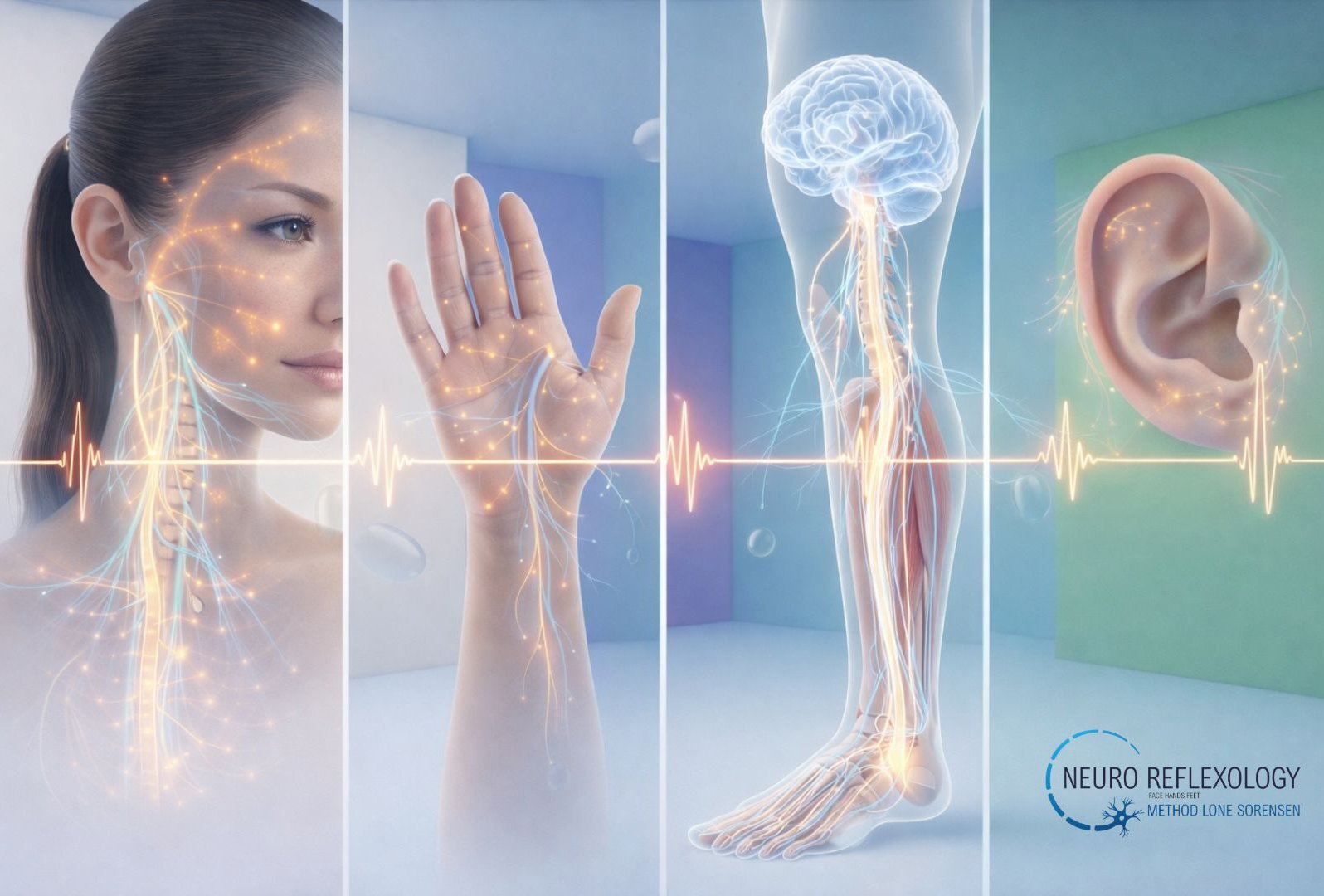
by Lone Sorensen
When the face, hands, feet, and ears are treated together, regulation becomes stronger. Neuro-Reflexology builds systemic resilience through the nervous system.
In modern therapy, we talk a great deal about symptoms. About what hurts and what is not working.
For me, health has always been about something more fundamental. About whether the body is capable of regulating itself.
Can it adapt to load?
Can it return to balance after illness?
Can it maintain stable function over time?
That capacity is what we call systemic resilience.
In Neuro-Reflexology, I do not work with forceful stimulation or attempt to correct the body from the outside. I work with the nervous system's ability to communicate and coordinate. When that communication improves, the body as a whole begins to regulate itself differently — with greater precision and often greater stability.
The face, hands, feet, and ears are not separate treatment areas. They are different sensory entry points into the same nervous system. When used deliberately and in combination, they support a form of whole-system regulation that cannot be achieved through any single entry point alone.
What Is Systemic Resilience?
Systemic resilience describes the body's overall capacity to handle load and return to balance. It is not about the strength of one organ, but about the quality of cooperation between the body's regulatory systems.
The nervous system, immune system, hormonal system, circulatory system, lymphatic system, and cellular processes are always working together. When this cooperation functions well, the body can adapt. When it does not, dysregulation develops — often long before any recognizable symptoms appear.
This is why the nervous system is always central to my work. It is where sensory information is received, integrated, and converted into a response. All reflex stimulation — whether through the face, hands, feet, or ears — functions in practice as information to the nervous system. That is where regulation begins.
Neuro-Reflexology is therefore not about influencing individual organs in isolation. It is about supporting the body's overall capacity for self-regulation.
The Nervous System as Regulator
The central nervous system and the autonomic nervous system function as the body's coordinating centre. They receive constant information from the body and its environment and adjust the body's responses accordingly.
When this regulation functions well, much happens automatically. The body recovers, adapts, and finds balance. When regulation is disrupted, we often see fixed patterns of stress, pain, inflammation, or impaired recovery.
In Neuro-Reflexology, I do not attempt to take over the body's work. I attempt to give the nervous system clearer and more precise information, so the body can once again regulate itself.
The Four Reflex Entry Points – Different Qualities, One System
I work with four reflex entry points because they provide the nervous system with different information. Not better or worse — but different.
Each contributes its own distinct quality:
The face offers fast and precise central regulation
The hands support integration and rhythm
The feet provide depth, grounding, and stability
The ear provides direct access to the autonomic nervous system
Each entry point has its function, and it is precisely this difference that makes the combination effective.
Facial Reflex Therapy
The face has a very high density of sensory receptors and a direct connection to the cranial nerves and brainstem. Reflex arcs are short, which allows for rapid and precise neural influence.
Facial Reflex Therapy is frequently used where autonomic regulation, mental and emotional balance, and central coordination in the brain are required. It is particularly suited to fine-tuning and to situations where the nervous system needs rapid stabilization.
Hand Reflexology
The hands play a central role in sensorimotor integration and continuous feedback to the nervous system. Reflex zones along the midline of the hand, the wrist, and the fingers relate closely to the chest axis and to immune and circulatory function.
Hand reflexology works gently but with an integrative effect. It supports rhythm and coherence in regulation and is often used when the body needs stable integration rather than rapid correction.
Foot Reflexology
The feet contain large reflex zones and have strong connections to the spine, motor pathways, and postural regulation. They play an important role in distributing and anchoring regulatory signals throughout the body.
Foot reflexology is often used in chronic conditions, motor rehabilitation, and situations where deep systemic support is needed.
Ear Therapy
The ear functions as a microsystem in which the entire body is represented, and it has a direct connection to the autonomic nervous system, including via the vagus nerve.
Ear therapy is particularly used for autonomic balancing, pain modulation, stress and trauma regulation, and rapid central stabilisation. The ear frequently provides effective access to regulation when the nervous system is overloaded.
From Reflex Input to Systemic Resilience
Regulation can be understood as a connected process. Sensory input from the face, hands, feet, and ears is integrated in the central and autonomic nervous systems. From there, the response is coordinated outward to the immune system, hormonal system, circulation, and lymphatics.
This regulation ultimately influences cellular energy production, repair processes, and inflammatory balance. Systemic resilience manifests at the cellular level, but it is governed through the nervous system.
Why Combine All Four Entry Points?
When multiple reflex entry points are combined, the need for forceful stimulation is reduced. The nervous system receives more nuanced information, and regulation tends to become more stable over time.
In practice, this means less load on the body, greater precision, and better long-term adaptation.
The face contributes precision, the hands contribute integration, the feet contribute grounding, and the ear contributes autonomic access. Together, they support the body's overall regulatory capacity.
Systemic Resilience as a Therapeutic Goal
When the focus shifts from symptom control to systemic resilience, the therapeutic approach changes with it. The goal is no longer to remove a single symptom, but to support the body's capacity for self-regulation.
This approach is particularly relevant in chronic and complex conditions, neurological presentations, immunological dysregulation, stress-related load, and in rehabilitation and recovery.
The Strongest Work Happens in the Whole
After more than 45 years of clinical work with reflexology and neuroregulation, one thing has become clear to me: the strongest treatment does not arise from mastering one technique, but from understanding the whole.
The face, hands, feet, and ears each represent a distinct entry point into the nervous system. Each has significant therapeutic value on its own. But it is only when all entry points are mastered — and when a practitioner understands when and how to combine them — that the deepest and most stable regulation becomes possible.
This integrated approach is the foundation of my training programmes. Not as a collection of techniques, but as a unified neuro-reflexological system that is adapted to each individual's needs and the current capacity of their nervous system.
If you are considering how this knowledge might apply in your own practice or your own process, the right place to begin is with a deeper understanding of the system as a whole.
Some questions do not require quick answers, but the right understanding.
It always starts with the nervous system.
***
About the Author
This article was written by Lone Sorensen — founder of Method Lone Sorensen and the International Institute of Neuro Reflexology, and the woman who developed Facial Reflex Therapy and its associated methods over nearly 50 years of clinical and educational work. She has trained practitioners and instructors across more than 40 countries. To learn more about her work, visit facialreflexologyschool.com
I, Jasmina Kotorac, am certified by Lone Sorensen as both a practitioner and instructor in Facial Reflex Therapy and Japanese Face Lifting, and am authorized to teach these methods to other practitioners. I hold the full Facial Reflexology diploma, the Temprana Brain Rehabilitation diploma, and advanced certifications across a range of specialized protocols — and am the only practitioner in Australia to have completed the Temprana training.
If you have questions about this article, the methods it describes, or how they might be relevant to your own situation, I would be glad to hear from you.
You can reach me by email at northwestreflexology@gmail.com or by phone at 0431 646 665