
Cholesterol – The Body's Repair Mechanism or a Number to Be Lowered?
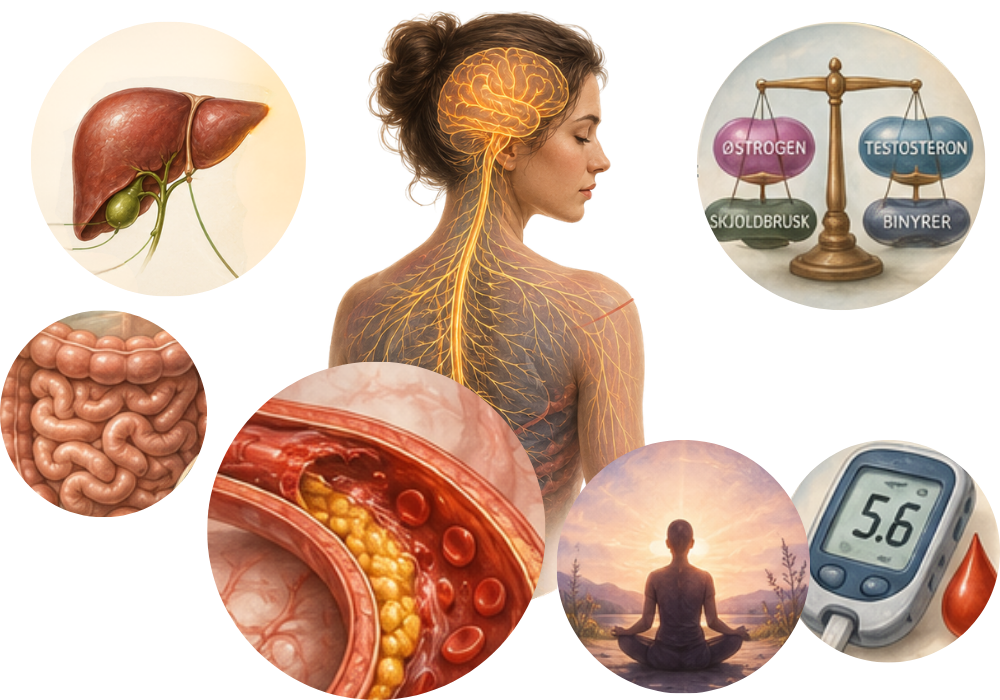
by Lone Sorensen
Few health topics generate more anxiety in clients than cholesterol. Many arrive for treatment with a blood test in hand and the experience of having received a verdict. The number is too high. Something must be done.
But as therapists, we should always ask ourselves a fundamental question: are we treating a number — or are we trying to understand why the body is producing that number?
There is a significant difference between the two.
Cholesterol is not a foreign substance
Cholesterol is not something the body produces by mistake. It is a substance that is essential to life. Without cholesterol, the body cannot produce hormones. Cell membranes lose their integrity. The nervous system weakens. And the brain — which contains a remarkable concentration of cholesterol — cannot function optimally.
Cholesterol is a central component of myelin, the protective insulation around the nerve conduction pathways. It is involved in communication between nerve cells, in memory processes, in learning, and in tissue and nerve regeneration. From a neuro-reflexology perspective alone, that is sufficient reason to regard cholesterol with far greater respect and curiosity than we typically do.
The question is not always: how do we lower cholesterol?
The question should more often be: what is the body trying to protect, repair, or compensate for?
The liver and gallbladder — the first place to look
The liver produces the majority of the body's cholesterol. It regulates fats, produces bile, and manages an enormous number of metabolic processes. If the liver is under load — from chronic stress, poor diet, medication use, inflammation, or metabolic imbalance — cholesterol regulation will shift accordingly.
Closely connected to the liver is the gallbladder. Cholesterol is primarily excreted via bile, and efficient bile flow is essential for the body's ability to process and eliminate excess fat. When bile flow is sluggish, digestion deteriorates and cholesterol metabolism becomes less effective. This is a connection many therapists overlook.
In my treatment planning, I work with the reflex zones for the liver, gallbladder, duodenum, and pancreas as a single integrated functional system — not as isolated organs.
The intestinal system, blood sugar, and hormones
Emerging research increasingly points to a connection between the gut microbiome and cholesterol regulation. Certain intestinal bacteria participate directly in cholesterol metabolism. Chronic inflammation, dysbiosis, and impaired nutrient absorption affect the body's capacity for self-regulation. Clients presenting with elevated cholesterol frequently have concurrent digestive difficulties — constipation, bloating, irregular bowel function. This is not coincidental.
Another important factor is blood sugar regulation. Many clients presenting with elevated cholesterol have, in reality, a glucose regulation problem — insulin resistance or metabolic syndrome — rather than an isolated cholesterol issue. Elevated triglycerides and abnormal cholesterol profiles are frequently seen alongside high insulin levels. It is the same underlying picture seen from two different angles.
The hormonal system plays an equivalent role. Cholesterol is the raw material the body uses to produce hormones. During menopause, andropause, with reduced thyroid function, or under prolonged adrenal load, the body's relationship to cholesterol shifts. Looking exclusively at laboratory values without assessing endocrine status produces an incomplete picture.
Chronic inflammation — perhaps the most important perspective
Many researchers today regard elevated cholesterol as part of the body's repair mechanism rather than as the primary cause of cardiovascular disease. Cholesterol tends to accumulate where there is irritation, inflammation, or tissue damage in the vascular system. Traditionally, this presence has been interpreted as the cause of the problem. But in many cases it may represent the body's attempt to repair tissue that is already under pressure.
This does not mean elevated cholesterol should be ignored. It means we should investigate what is driving the inflammation in the first place.
Poor diet, smoking, chronic stress, sedentary lifestyle, sleep disruption, and unaddressed inflammatory conditions all affect the body's internal environment. As neuro-reflexology therapists, we know that the nervous system plays a central role in regulating these processes. Chronic activation of the sympathetic nervous system affects blood sugar, digestion, hormone production, circulation, and inflammatory responses throughout the body.
Nervous system support is therefore at least as important as supporting the liver and digestive system.
The clinical approach
When I work with clients presenting with elevated cholesterol, the goal is not to change a number. The goal is to help the body regain balance in the systems that govern its health: liver, digestive system, hormonal system, circulation, immune system, and nervous system.
In practice, this means I assess liver function and bile flow, the state of the gut microbiome, blood sugar regulation, hormonal balance, the degree of chronic inflammation, and the load on the autonomic nervous system. The treatment protocol is built on that complete picture — not on a single number.
The body has a remarkable capacity for self-regulation. When digestion improves, inflammation reduces, stress is addressed, hormonal balance is restored, and circulation is supported, cholesterol regulation frequently normalises as a natural part of broader physiological balance.
Cholesterol is not the body's enemy. It is part of a complex biological conversation that takes place in the body every single day. The better we learn to listen to that conversation, the more effective we become at supporting real clinical change.
***
About the Author
This article was written by Lone Sorensen — founder of Method Lone Sorensen and the International Institute of Neuro Reflexology, and the woman who developed Facial Reflex Therapy and its associated methods over nearly 50 years of clinical and educational work. She has trained practitioners and instructors across more than 40 countries. To learn more about her work, visit facialreflexologyschool.com
I, Jasmina Kotorac, am certified by Lone Sorensen as both a practitioner and instructor in Facial Reflex Therapy and Japanese Face Lifting, and am authorized to teach these methods to other practitioners. I hold the full Facial Reflexology diploma, the Temprana Brain Rehabilitation diploma, and advanced certifications across a range of specialized protocols — and am the only practitioner in Australia to have completed the Temprana training.
If you would like to learn these methods, feel free to reach out to me by email at: northwestreflexology@gmail.com or call me at : 0431 646 665