
What Can You Use the Training in Facial Zone and Reflex Therapy For?
by Lone Sorensen
I am often asked what the training in Facial Zone and Reflex Therapy can actually be used for.
The straightforward answer is that it gives you the tools to work more precisely, more neurologically, and more holistically with people — either as a new professional direction or as an extension of what you already do in your practice.
Some of my students use the training to open their own clinic. Others integrate the method into their existing work as practitioners, therapists, nurses, or educators. Some work with stress and hormonal imbalances. Others with pain, neurological conditions, children with special needs, or rehabilitation.
What matters is not only that you learn a technique. What matters is that you learn to read the body's signals and build a treatment from cause, not just symptom.
I developed this method through more than 45 years of clinical work, research, and teaching across many countries. It was not created as theory alone. It grew out of real encounters with real people, real clinical presentations, and a continuous need to be able to help more precisely.
I began with zone therapy at an early stage in my career, but I quickly found that I needed to go further if I truly wanted to understand the body, the nervous system, and the complex imbalances I was meeting in clinical practice. That became the beginning of a long professional development that took me from Denmark to Argentina, on to Cuba, and later to Spain, where I continued to research, treat, and teach.
What My Students Use the Training For
My students come from very different backgrounds. Some are already practitioners. Some want to change direction. Others are starting from the beginning. What they share is a desire for a method that translates directly into practice.
For some, the training marks the beginning of a new clinic.
Eva Duckert describes it this way: "Every day I'm grateful that in 2006 I trained as a Facial Reflex Therapist. With Facial Reflex Therapy I discovered I was getting better and faster results than with my classical foot zone therapy. For me it meant that I got to live my dream... I got the opportunity to make a professional living from my treatments. Every single day is exciting and it is incredibly rewarding to be able to help so many people live better lives."
For others, the focus is on strengthening the work they already do.
Anne Dorthe began combining coaching with Facial Zone and Reflex Therapy, particularly in her work with clients experiencing stress, and describes how it gave her a more holistic way of helping people. She later built on this with hormone courses, mother-and-baby work, and courses directed at children with special needs.
Others find they can begin working professionally with the method very quickly. Marianne shares: "Already during module 2 I was fully booked for student treatments — I simply could not fit any more into my calendar. My clients have taken to facial reflex therapy wonderfully, and I have received so many positive responses."
And Hanne Boe says: "I had high expectations — and they have been met. The teaching is thorough, there is plenty of hands-on work and opportunity to practise and exchange with the other students. Already after module 2 I was able to start treating. Now everything is beginning to fall into place — and that gives an enormous sense of confidence."
What You Gain from the Training
When you train with me or one of my instructors, you do not only learn where to work on the face. You learn to analyse tissue reactions, understand the connections between the nervous system, organ function, the hormonal system, and emotional load — and to build individual treatment protocols.
This means you develop:
— a concrete and systematic method
— a deeper understanding of underlying causes
— practical tools you can apply directly in treatment
— the ability to integrate the method into your existing practice
— a professional foundation for starting something new or building further
For some this brings professional confidence. For others it opens new clinical possibilities. For many it brings both.
Neuro-Reflexology – Why the Nervous System Is Central
A central concept in my work is neuro-reflexology.
This means working with reflex areas and points in the body based on how the nervous system functions. When specific areas of the face, hands, or feet are stimulated correctly, impulses are sent through the nervous system to the brain, which registers and responds to the stimulation.
The brain functions as the body's central regulatory organ. It governs the hormonal system, blood circulation, muscle activity, organ function, and many of the processes that keep the body in balance.
Working neuro-reflexologically, treatment is therefore not only about relieving a symptom locally. It is about influencing the regulatory systems that lie behind it.
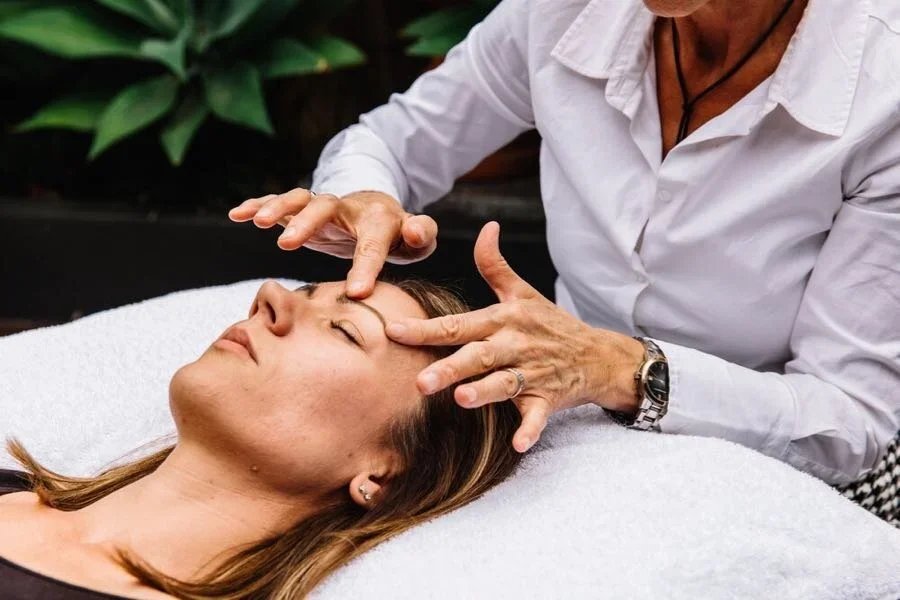
On the face alone, we work with several hundred nerve points and reflex areas that connect to the brain's functional regions. This is why facial reflex therapy can often produce a rapid neurological response throughout the body.
The same understanding underlies other parts of my work — Neuro-Foot Zone Therapy, Neuro Hand Reflexology, and several of my specialized courses — all of which use reflex zones to influence the nervous system and the body's overall regulation.
Clinical Experience – Where the Method Began to Take Shape
Many of the methods I teach today were developed through direct clinical work with patients.
In Argentina, I worked with a woman who had sustained a brain injury as a young person and was severely spastic. I had never worked with a patient like this before. I began with foot zone therapy, but without clear results.
I then began working on the face, using reflex zones and nerve points. Within just a few minutes of treatment, I could see her body beginning to release. It was a response I had never observed to the same degree before.
She received treatment several times a week over an extended period, using a combination of facial reflex therapy, nerve points, and foot zone therapy. After approximately one year, she was able to manage daily life independently again, and her condition had improved markedly.
Another case from my time in Argentina involved a young woman who, following a car accident, was paralyzed and unable to swallow. She was being fed intravenously.
After daily treatments with facial reflex therapy and neurological points, she began to swallow again after several weeks. These experiences were decisive for me. They showed me how powerfully the nervous system can respond when you work precisely with reflex areas close to the brain.
It was through many similar cases that the method was gradually developed and systematized.
Why I Teach
I do not teach simply to pass on techniques.
I teach because throughout my life I have seen what it means when knowledge does not stay with one person, but is passed on in a way that others can use responsibly and precisely.
When I was working intensively with patients in Argentina, it became clear to me that the need was greater than any one clinic could meet. I could not reach everyone who needed help. So I began to train others.
First therapists. Later also parents and family members, so they could work with their children at home.
Specialisation and Continued Training
An important part of my work is the continued development of new methods and specialisations. Throughout my career I have studied treatment systems from around the world — from Oriental medicine and Vietnamese microsystems to Tibetan medicine and neurological reflex therapy. I continue to investigate, test, and develop new treatment protocols in clinical practice. When I find methods or connections that produce better results, I work further with them, systematise them, and integrate them into new treatments, frameworks, and teaching programmes.
Beyond Facial Zone and Reflex Therapy, you can also train in:
— Japanese Cosmo Lifting
— Neuro-Foot Zone Therapy
— Neuro Hand Reflexology
— Temprana Reflex Therapy
— A range of specialised courses in neurology, the hormonal system, the vagus nerve, pain treatment, and other specific areas
Many students later choose to deepen their work in one or more of these areas and build a practice with multiple treatment modalities.
***
About the Author
This article was written by Lone Sorensen — founder of Method Lone Sorensen and the International Institute of Neuro Reflexology, and the woman who developed Facial Reflex Therapy and its associated methods over nearly 50 years of clinical and educational work. She has trained practitioners and instructors across more than 40 countries. To learn more about her work, visit facialreflexologyschool.com
I, Jasmina Kotorac, am certified by Lone Sorensen as both a practitioner and instructor in Facial Reflex Therapy and Japanese Face Lifting, and am authorized to teach these methods to other practitioners. I hold the full Facial Reflexology diploma, the Temprana Brain Rehabilitation diploma, and advanced certifications across a range of specialized protocols — and am the only practitioner in Australia to have completed the Temprana training.
If this article has raised questions about whether training in these methods might be right for you, I would be glad to talk it through. You can reach me by email at northwestreflexology@gmail.com or by phone at 0431 646 665