
Regulation of the Endocrine System through Facial Neuro-Reflexology
A Neuro-Regulatory Approach to Hormonal Balance in the Sorensensistem™ Method
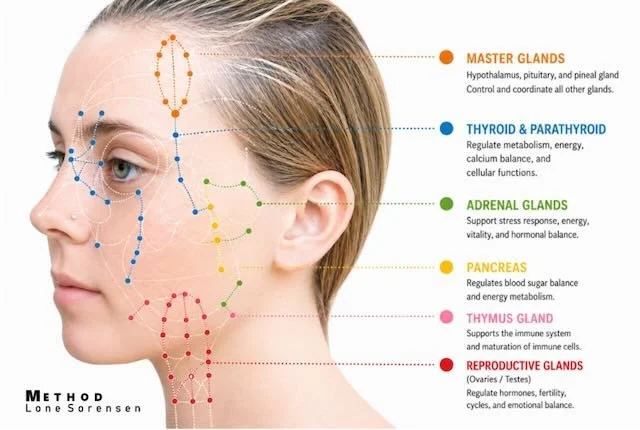
The endocrine system is a highly sophisticated network responsible for regulating hormonal balance, metabolism, stress response, growth, and emotional stability. Its function depends not only on the activity of individual glands, but on the precision of communication between the brain and the body.
In clinical practice, many dysfunctions are not caused by isolated gland failure, but by disturbances in regulation, signaling, and coordination.
Facial Neuro-Reflexology, as developed in the Sorensensistem™ Method, addresses this complexity through a structured approach that works simultaneously on central regulation and peripheral glandular function.
An Integrated Approach: Master Glands and Individual Glands
In Facial Neuro-Reflexology, the endocrine system is approached as an integrated regulatory network, where both the master glands and the individual endocrine glands are treated in a coordinated way.
The method operates on two essential and interconnected levels:
Central regulation through the master glands—the hypothalamus, pituitary, and pineal glands—responsible for coordination, timing, circadian rhythm, and hormonal signaling.
Targeted stimulation of individual glands—including the thyroid, adrenal glands, pancreas, and reproductive organs—through specific reflex zones, nerve points, and complementary systems such as the Colon Link Methods.
The therapeutic effect does not arise from treating one or the other, but from combining both levels into a functional whole.
Hormonal balance is not created in one gland—it is created through the communication between them.
Why the Face Is a Powerful Endocrine Access Point
The face provides a unique and highly effective interface for influencing endocrine regulation due to its:
High density of cranial nerve endings
Direct connections to the brainstem and hypothalamic centres
Multiple overlapping microsystems within different tissue layers
Rich vascular and lymphatic networks enabling rapid systemic response
Through precise stimulation of facial reflex areas and points, the therapist can influence neuro-endocrine signalling, enhance circulation, and support systemic regulation.
This is not a symbolic representation of the body—it is a functional neuro-regulatory system.
The Role of the Master Glands
Hypothalamus – The Integrative Regulator
The hypothalamus links the nervous system with the endocrine system, integrating emotional, metabolic, and environmental information.
Stimulation supports:
Regulation of the stress response
Autonomic nervous system balance
Circadian rhythm and healthy sleep patterns
Pituitary Gland – The Command Centre
The pituitary gland orchestrates hormonal signalling throughout the endocrine system.
Stimulation supports:
Improved communication with peripheral glands
Coordination of hormonal release
Stabilisation of endocrine feedback loops
Pineal Gland – The Rhythmic Modulator
The pineal gland regulates biological rhythms and plays a key role in sleep–wake cycles and neuro-hormonal timing.
Stimulation supports:
Circadian synchronisation
Hormonal timing and rhythm
Neurochemical balance
Access to Individual Endocrine Glands
In addition to central regulation, the method provides direct access to individual endocrine glands through advanced reflex systems.
Thyroid and Parathyroid
Regulation of metabolism and calcium balance
Support for energy production and oxygenation
Adrenal Glands
Modulation of the stress response
Support for healthy cortisol rhythm and adaptation
Pancreas
Regulation of glucose metabolism
Stabilisation of energy levels
Reproductive Glands (Ovaries/Testes)
Hormonal cycle regulation
Integration of emotional and endocrine responses
Advanced Access Pathways: Nerve Points and Colon Link Methods
A defining feature of the Sorensensistem™ Method is the use of additional access systems that deepen endocrine regulation.
Nerve Point Stimulation
Targets specific neural pathways connected to endocrine organs, enhancing communication between the central nervous system and glandular structures.
Colon Link Methods
Recognise the functional relationship between the digestive system and endocrine balance, supporting detoxification, metabolic regulation, and hormonal stability.
Together, these systems allow the therapist to bridge central control with peripheral function, creating a more complete therapeutic response.
The Neuro-Regulatory Mechanism
Facial Neuro-Reflexology works through a sequence of physiological responses.
1. Sensory Activation
Precise pressure and movement stimulate receptors in the skin and connective tissue.
2. Neural Transmission
Signals travel via cranial nerves to the brainstem and hypothalamic centres.
3. Central Regulation
The brain processes and adjusts autonomic and endocrine responses.
4. Peripheral Response
Improved circulation, lymphatic flow, and glandular function follow.
Layered Stimulation: A Core Principle
The method applies stimulation in layers, with each layer influencing different physiological systems.
Superficial layer → Sensory and neural activation
Intermediate layer → Vascular and lymphatic support
Deep layer → Targeted neuro-endocrine signalling
This layered approach allows for precise modulation of both central and peripheral systems.
Clinical Applications
This integrated approach may support clients experiencing:
Chronic stress and burnout
Hormonal imbalance (thyroid, adrenal, or reproductive)
Sleep disturbances
Menopause and hormonal transitions
Emotional instability linked to endocrine dysregulation
Metabolic imbalance
The most effective protocols generally follow a structured sequence:
Regulation of the nervous system
Activation of circulation and lymphatic flow
Combined stimulation of the master glands and individual endocrine glands
From Isolated Treatment to Coordinated Regulation
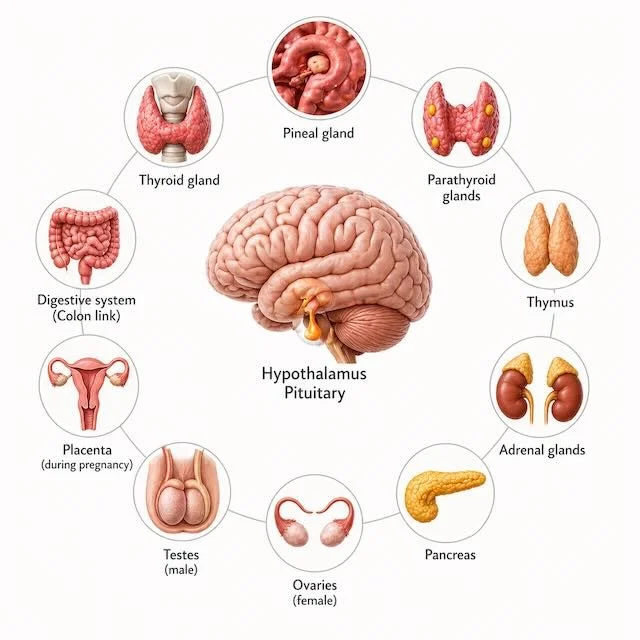
The strength of Facial Neuro-Reflexology lies in its ability to move beyond isolated treatment approaches.
Instead of:
Treating individual glands separately
Focusing only on symptoms
The method focuses on:
Restoring communication between systems
Coordinating central and peripheral regulation
Supporting the body's inherent capacity for balance
Conclusion
Effective endocrine regulation requires more than influencing individual glands—it requires restoring the network that connects them.
Facial Neuro-Reflexology offers a structured and clinically applicable method to:
Regulate the master glands
Activate individual endocrine organs
Integrate central and peripheral function into a unified physiological response
By working through the face as a neuro-regulatory interface, the therapist engages directly with the body's control systems—where true hormonal balance begins.